Tuesday, 17 May 2022

LIBOR-SOFR transition - still many unknowns

We start this week with a LCH consultation regarding the Conversion of Outstanding Cleared USD LIBOR Contracts. No big surprise in the content of the consultation itself. It is roughly the same a proposal for USD in June 2023 than the one for GBP in December 2021.

But this consultation is also the occasion to remember the uncertainty surrounding cleared LIBOR trades, the OTC versions at LCH and CME but also the ETD futures versions at CME. Each trade involving a LIBOR fixing beyond June 2023 need a precise fallback. The cleared trades don't have a precise fallback yet. The existence of the consultation, almost 5 years after the "Future of LIBOR" speech, is a reminder that the transition is still unplanned. The figures below illustrate that LIBOR still attracts more volume than SOFR. But a lot of those LIBOR-linked trade are for an unknown term sheet. 

The cleared swaps term sheet can be modified unilaterally by the CCPs using unknown mechanisms. The LIBOR futures will be transformed into SOFR futures at an unknown date and with unknown mechanisms. Yes, those mechanisms have been roughly described and there is an expectation that there will be little modification of them. But remember, for the ISDA definition, there was a consultation and then after the results were announced, the actual meaning of the different fallback mechanism was decided by Bloomberg! For cleared GBP swap at LCH, it was announced that the ISDA mechanism would be copied, only to decide later that a different mechanism would be used.

As model validators, we don't understand how the trading of Eurodollar futures or cleared LIBOR swaps can be validated from a quant perspective when the exact term sheet is still unknown.

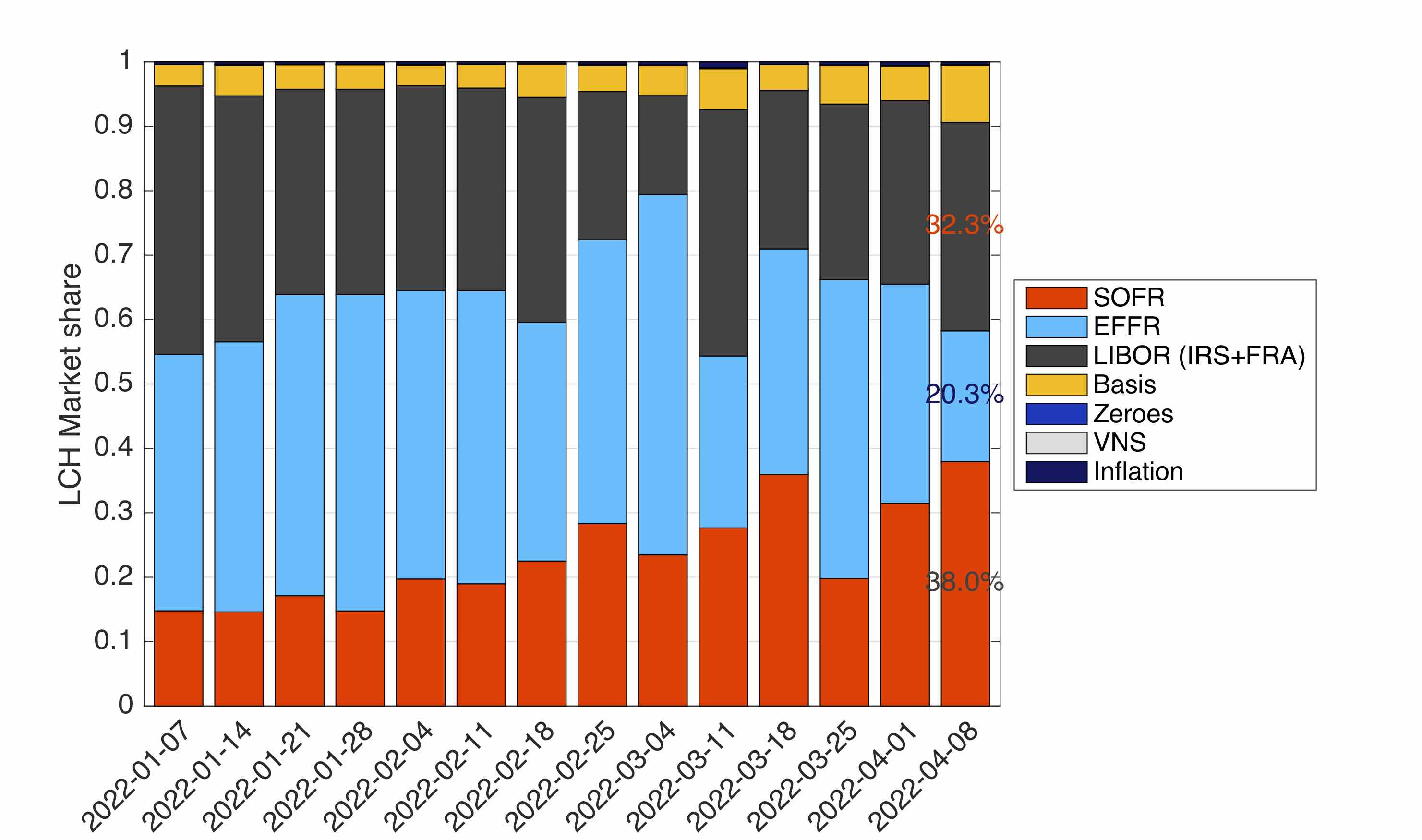
Coming back to our weekly statistics, we see that at LCH, from a volume perspective, SOFR is still third. Five months into 2022, we certainly have not achieved "SOFR First" in a stable way.

Figure 1: Weekly share by product types at LCH

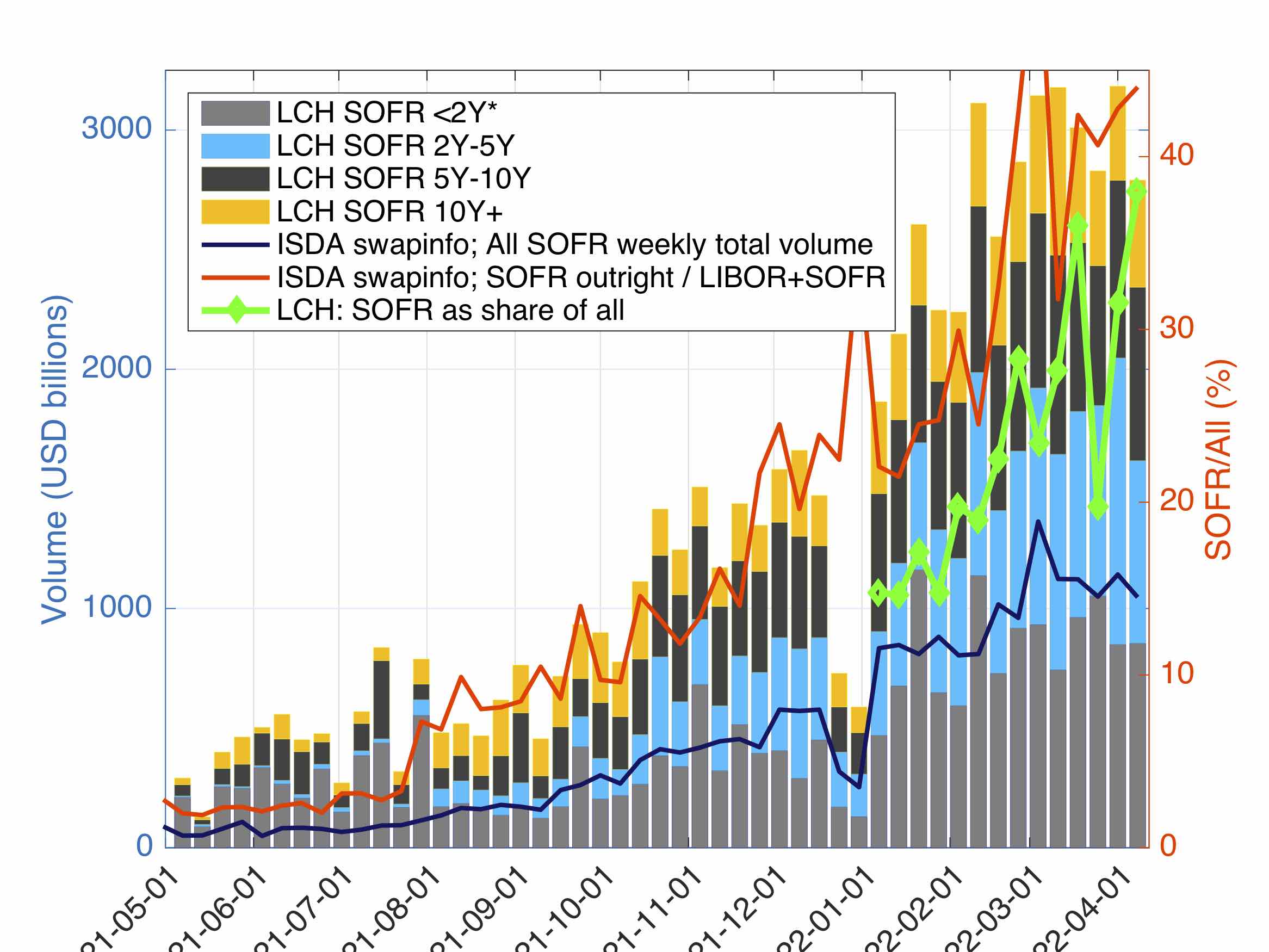
Last week, the SOFR relative volume was around 29.0%. It has been lower than both the LIBOR and the EFFR volumes for several weeks now. On an absolute basis, the volume has not been increasing either. Last week volumes at LCH and as reported by ISDA are lower than the one reported in February as displayed in Figure 2.

Figure 2: Weekly SOFR volume at LCH and as reported by ISDA (US regulatory figures based).

The futures do not paint a very different picture. The volume of LIBOR-3M futures is still above the volume of SOFR-3M futures each and every day, as displayed in Figure 3.

Figure 3: Daily futures volume at CME.

The activity in LIBOR futures is certainly not all risk reducing as regulators would like. Since the beginning of the year almost 222 million LIBOR futures contract have been traded. Over the same period, the open interest in the same futures has decreased by a pale 660,000 contracts. A maximum of 0.3% of the trades are risk reducing. We say "maximum" as a certain amount of trades expired on a monthly basis — we don't have the expiry figures so cannot adjust the above figure.

Tuesday, 10 May 2022

SOFR still third and other RFR's volume decreasing

For the second week in a row, SOFR is coming third in the benchmark race at LCH. Its share is down to 27.4%.

Figure 1: Weekly share by product types at LCH

On an absolute basis, the SOFR figures are not great either. The weekly traded notional was around 2.3 trn, which is a level similar to January. The volume has peaked at 3.2 trn at the beginning of April. The SOFR volume decrease is also visible in the ISDA/US regulatory figures.

Figure 2: Weekly SOFR volume at LCH and as reported by ISDA (US regulatory figures based).

If we look at the currencies for which LIBOR has been discontinued (GBP, JPY and CHF), we see a common behavior for the outstanding amounts at LCH: they are all decreasing since the start of the year (hyphened lines). We don't have a direct explanation. It can be a combination of: better use of compression for overnight, market participants less comfortable with OIS than with IRS, transfer to other CCPs (JSCC for JPY, EUREX for CHF), or something else. But certainly it is worth keeping an eye on it as it seems common to the three currencies.

Figure 3: End of week outstanding notionals at LCH for GBP (SONIA), JPY (TONA) and CHF (SARON).

Wednesday, 4 May 2022

SOFR: one step forward, one step backward.

Just one graph this week.

We are back to "SOFR Third" at LCH!

Figure 1: Weekly share by product types at LCH

Thursday, 28 April 2022

SOFR First - Step 1.5!

One month ago we published a blog titled "SOFR First - Step 1!". This was the fist week where at LCH there was more SOFR swaps traded than LIBOR swaps. We also indicated that for STIR futures at CME, LIBOR was still well above SOFR in volume terms.

This week we can indicate that "Step 1.5" in SOFR first has been reached. The daily volume of SOFR-3M futures is still less than the LIBOR-3M one, but for the first time, there was one day (Tuesday 19 April) where the combined volume of SOFR-3M and SOFR-1M surpassed on the LIBOR-3M one. You may have received some marketing email from CME indicated this milestone — even if the mail was not clear on the fact that this was achieved only by combining SOFR-3M and SOFR-1M. If you take the contract individually, LIBOR-3M has still more volume than SOFR-3M every single day. On the 1M side, EFFR-1M has still more volume than SOFR-1M every single day. This is why we call this step by the name of "1.5". The true "Step 2" will be when SOFR-3M volume is above LIBOR-3M volume and maybe "Step 3" when SOFR-1M volume is above EFFR-1M volume.

Returning to the LCH OTC cleared side, since that first "SOFR First - step 1" week, the SOFR, EFFR and LIBOR shares have battled for the leadership. The weekly shares are provided in Figure 1. SOFR hase been the main benchmark for a couple of weeks, but still far away from registering 50% of the OTC swap volume.

Figure 1: Weekly share of product types at LCH

The volume has been flat on an absolute basis over the last 8 weeks. The increase in market share is more due to the decrease in LIBOR and EFFR than the increase in SOFR.

Figure 2: SOFR volume evolution and share among tenors.

The oustanding amount has been steadly increasing for SOFR and has now reached the EFFR level. The LIBOR outstanding amount is almost unchanged since the beginning of the year, confirming that the activity on LIBOR is not all risk reducing.

Outstanding volume

Figure 3: LIBOR, EFFR and SOFR outstanding volumes at LCH.

The daily volume in STIR futures at CME is displayed in Figure 4. The "Step 1.5" is not directly visible on the graph, but by adding the SOFR-1M to the SOFR-3M volume on 19 April, the totla is larger than the LIBOR-3M volume. Up to know, this was a one-off. We will indicate the real "Step 2" in our blogs as soon as we see it hapenning.

Futures daily volume

Figure 4: Daily futures volume at CME.

On the open interest side, the situation is a continuation of the developments since the begining of the year. An very small decrease in LIBOR open interest — indicating once more if needed that the vast majority of the LIBOR trades are not risk reducing — and a significant increase in the SOFR open interest and a smalller one in EFFR open interest. The OI in SOFR-3M futures has not reach 50% of the LIBOR-3M futures yet. The increase in SOFR and EFFR is probably linked in part to the change in monetary policy and not only to the benchmark transition. The total STIR futures OI has significantly increased since the start of the year.

Figure 5: Futures Open Interest at CME

Wednesday, 13 April 2022

SOFR progress: 2022-04-08

Graphs without comment this week.

Figure 1: Weekly share by product types at LCH

Figure 2: SOFR volume evolution and share among tenors.

Saturday, 9 April 2022

New working paper: Options on overnight futures

We are pleased to announce a new working paper titled

Options on overnight futures

is available in our muRisQ Advisory Model Development series of research papers. The paper is available on SSRN preprint repository at http://ssrn.com/abstract=4068731.

Abstract

With the transitions to overnight benchmarks as the main benchmarks in some currencies, futures based on overnight rates are becoming more common. The most traded futures on overnight rates settle agains compounded rates. The pricing of those futures requires some convexity adjustments with an Asian flavour due to the composition. Together with the greater liquidity of those futures came the market for options on futures. The options are traded with the usual futures daily margin mechanisms and can be standard options or mid-curve options; the options themselves are European or American. The pricing of those options, require different adjustments for the margin and composition features. In this note we propose the pricing of those options in the Gaussian HJM framework.

Wednesday, 6 April 2022

SOFR in 2022 Q1: slow progress

2022 was suppose to be the year where USD-LIBOR was only used for risk reduction. The end of Q1 has come and that has not happen. 

There has been progress on the LIBOR transition and on SOFR developments but they can only be qualified as "slow" and not all LIBOR transition goes in SOFR direction.

Let's start with the SOFR progress part. This is clearly visible in Figure 1 which displays the SOFR volume at LCH and as reported by ISDA (in Swap Info).

Figure 1: SOFR volume evolution and share among tenors.

The SOFR progress is clearly visible with the volume roughly tripling over the last 6 months.

On the LIBOR side, there has been a clear decrease in volume but far away of the one we would have expected from a"prohibition of new use" as decided by the FCA. Since the beginning of the year, the LIBOR volume represent roughly 31% of the USD 165 trn traded in USD derivatives at LCH. The weekly benchmarks shares are displayed in Figure 2. 

Figure 2: Weekly share of product types at LCH

One obvious feature of the market share, is that is the USD derivative market is not based on a pure LIBOR-SOFR transition, but there is a third major participant: EFFR. Even without the support of the regulators and without the automatic conversion of some LIBOR trades, EFFR represent around one third of the market. The EFFR trades are concentrated on the short end of the curve.

As explained in previous blogs, this is a problem for SOFR as the term SOFR rates (CME and IBA version) are currently not based on "level 1 waterfall" — quoted OIS in the interbank market. It makes the pricing and hedging of those terms rates and the associated basis, which in theory should be 0, relatively difficult.

On the STIR futures side, the situation is not very different. SOFR is progressing and LIBOR is decreasing, but we are still very far way from a transition. EFFR is also playing a non-negligible role. The daily volumes over the last 6 months is displayed in Figure 3.

Figure 3: Daily volumes for STIR futures at CME.

We look at the STIR futures in two blocks: the 3 months futures and the 1 month futures. The 3 months are the most liquid and composed of three types: LIBOR, SOFR and BSBY. The daily share of SOFR has been between 12.4% and 42.5%, it has never been the most traded futures on any single day. The share of BSBY is anecdotic, between 0 and 1%. LIBOR is still by far the dominant futures with more than 70% of the average daily volume. The 1 month is composed of only two types: SOFR and EFFR. The daily share of SOFR is between 8.3% and 29.7%. Fed Funds futures are still largely dominating SOFR with with around 85% of the average daily volume.

Wednesday, 30 March 2022

Oops! Back to SOFR third!

Last week we reported the first "SOFR First" week, at least in term of volume at LCH. This week we are already back to "SOFR Third" as displayed in Figure 1. The SOFR share fell significantly to 19.8% from 36.0% while EFFR increased to 46.4% and LIBOR to 27.3%. In DV01 terms the shares may be different as a lot of the EFFR trades are shorter term.

Figure 1: Weekly share of product types at LCH

The large changes in share are due to a slight decrease in SOFR trading but significant increase in EFFR and LIBOR trading as displayed in Figure 2. The ISDA/US regulatory figures also display a decrease in SOFR share.

Figure 2: SOFR volume evolution and share among tenors.

In absolute terms for the outstanding amounts, SOFR is also third as displayed in Figure 3. The only slightly positive note for SOFR is the continuous increase in outstanding amounts at LCH while LIBOR outstanding amounts have been decreasing for the last 4 weeks.

Figure 3: LIBOR, EFFR and SOFR outstanding volumes at LCH.

Tuesday, 22 March 2022

"SOFR First" - Step 1!

Finally, 5 years after the "The future of LIBOR" speech, 1 year after the death date announcement, more than 6 months after regulators "SOFR First" announcement, we have reach the first step in "SOFR First". "SOFR First" is for the first time a reality in LCH cleared weekly volumes. The SOFR first is still very partial as it does not appear in ISDA/US regulatory or in CME futures figures.

On LCH side, SOFR is first with 36.0%, EFFR second with 35.0% and LIBOR third with 24.6%. SOFR has a relative majority, slightly above one third of the volume but still far from an absolute majority. On the US regulatory figure, outright SOFR is 42.4% of a total that does not include EFFR (not reported in ISDA figures). The change of volume share is mainly due to the decrease in LIBOR and EFFR volume; the SOFR volume is practically unchanged over the last 5 weeks.

Figure 1: Weekly share of product types at LCH

Last week also saw the launch of the ICE Term SOFR Reference Rates. There was already a SOFR Term rate, administered by CME, but to our opinion that benchamrk is less convenient. The CME benchmarks are based on futures prices and obtained through some arbitrary intepolation mechanism and some weighted average over the day while the ICE benchmarks are based on actual market prices for the given tenors at a given point in time.

This lead to Figure 2, where the volume of SOFR swaps and its split by tenor is displayed. We can see the trend already mentionned in previous blogs (e.g. here) which is that with respect to other overnights benchmarks, the share of short term swaps is relatively low. The volume in the USD OIS short term market is mainly in EFFR-OIS. The liquidity is not there yet to use level 1 inputs in the benchmark waterfall. Level 1 inputs are "eligible, executable prices and volumes for relevant and eligible overnight interest rate swaps referencing the relevant RFR, provided by regulated, electronic trading venues". For the moment only Level 2 inputs, i.e. "eligible dealer-to- client prices and volumes".

Figure 2: SOFR volume evolution and share among tenors.

The outstanding volume continue to decrease slighlty for LIBOR and increase for SOFR.

Figure 3: LIBOR, EFFR and SOFR outstanding volumes at LCH.

On the futures side, we are still far away from SOFR First. LIBOR is still the dominant force, both in terms of daily volume (Figure 4) and open interest (Figure 5). Over last week the market share at CME was LIBOR-3M at 53.7% (2.4 m ADV), SOFR-3M at 32.7% (1.5m ADV), EFFR-1M at 11.4%, SOFR-1M at 2.2% and BSBY at 0.1%. There has not been a single day where SOFR-3M volume was above LIBOR-3M volume. On the futures side, we are still waiting the "SOFR First" first day. On the one month contracts, EFFR is well above SOFR-1M, a market feature parallel to the swap market where short term EFFR-OIS dominated SOFR-OIS.

Figure 4: Daily futures volume at CME.

The open interst is almost unchanged for LIBOR since the start of the year, with only a small dip on 15 March with the expiry of the March contracts. The SOFR-3M open interests continue to increase and also dipped at mid-month (on 17 March, due to a different expiry mechanism).

Figure 5: Futures Open Interest at CME

New published paper: Swap Rate: cash settled swaptions in the fallback

We are pleased to announce that the research paper written by Marc and titled

Swap Rate: cash settled swaptions in the fallback

has been accepted for publication in Risk. The publication date will be announced later.

The preprint version of the paper is part of the muRisQ Advisory Model Development series of research papers. The paper results have been presented in different seminars and conferences, including the The 4th Interest Rate Reform Conference on 20 October 2021.

Abstract

With the planned cessation of LIBOR, the LIBOR-based Swap Rates will also cease. For legacy transactions linked to it, a fallback is required. Some approximated fallback mechanisms have been proposed by working groups. The approximations involve some non-linear function of overnight-based swap rates. Due to the non-linearity, cash settled vanilla swaptions are becoming exotic products. Moreover, keeping the annuity unchanged while changing the rate to overnight-based swap generates technical issues in the pricing leading to convexity adjustments. The article proposes different pricing methodologies for those now exotic swaptions, including several price approximation to reduce the implementation numerical complexity.