Wednesday, 20 July 2022

LIBOR, EFFR and SOFR still playing yo-yo!

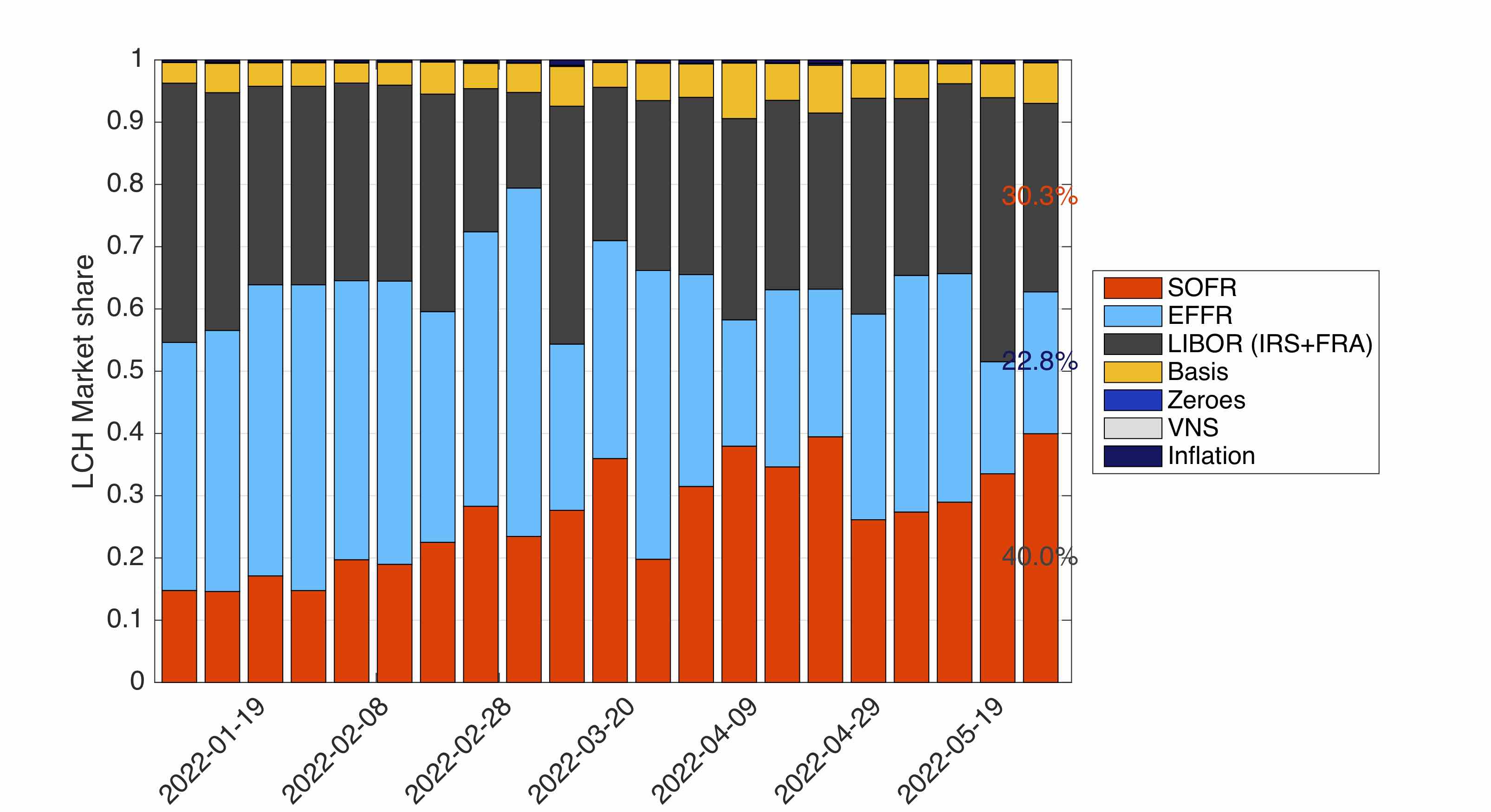
USD-LIBOR trading should have stopped more than 6 month ago, but in the market figures there is still large activity around it. From week to week, the dominant benchmark in the USD derivative market change from LIBOR to SOFR to EFFR. Last week the winner was EFFR, the week before it was SOFR and another week before is was LIBOR.

Figure 1: Weekly share by product types at LCH

We are still far away from a all-in in SOFR; maybe we will never go there!

Figure 2: Weekly SOFR volume at LCH and as reported by ISDA (US regulatory figures based).

Wednesday, 13 July 2022

Getting closer to SOFR First!

Getting closer to SOFR First! The SOFR share at LCH was last week at 43.7%, highest share and getting closer to 50%.

Figure 1: Weekly share by product types at LCH


Note that there is no more LIBOR swaps outstanding at LCH in GBP and JPY. We had to wait July to make such an announcement as the last LIBOR-6M, fixed at the end of December, were paid at the end of June (GBP, T+0) and beginning of July (JPY, T+2). In CHF, there is still CHF 30 millions of LIBOR swaps outstanding; this is probably a LIBOR-12M swap with one coupon still to be paid.

Tuesday, 5 July 2022

LIBOR Transition: Back to "LIBOR First"

For the first time in a while, we are back to "LIBOR First" at LCH and for US regulatory figures.

Figure 1: Weekly share by product types at LCH

The story told by the ISDA published US regulatory figures is similar (see Figure 2). For those figures also, LIBOR is back to the fore. This can be seen with the ratio SOFR outright/(LIBOR+SOFR) which is back below 50%.

Figure 2: Weekly SOFR volume at LCH and as reported by ISDA (US regulatory figures based).

There are more and more discussion about allowing a wider use of the SOFR Term rate. This is based on its usage in cash products. Derivatives are (or at least should be) designed to help risk management. If derivatives cannot be based on the same underlying benchmark as the cash product, they become less useful. This is the case for Term Rate based swaps but also optional products like cap/floor. Some cash products have explicit or implicit cap or floor, but currently they cannot be hedged easily in the wholesale market.

Issues regarding the SOFR Term rate itself can also been seen in Figure 2. The short term part of the SOFR-OIS (less than 2 year) is not large. This means that it is difficult to established a term rate based on liquid regulated electronic trading venues (Level 1 waterfall). We have mentioned this issue in several blogs and presentation (see here for example). Currently, CME SOFR Term rate is based on level 3 of the waterfall (futures) and IBA SOFR Term rate is based on level 2 of the waterfall (dealer to client). Also when using futures, creating the term rate requires some arbitrary interpolation scheme choice and has some timing issue.

With only one year to go to the LIBOR end date, this is not very good for the transition!

Sunday, 3 July 2022

Published paper: Swap Rate: cash settled swaptions in the fallback

The paper on the swap rate fallback and its impact on cash-settled swaptions announced in March has now been published in Risk.

Swap Rate: cash settled swaptions in the fallback

The paper is available on the Risk web site at

www.risk.net/7951001.

Abstract

With the planned cessation of LIBOR, the LIBOR-based Swap Rates will also cease. For legacy transactions linked to it, a fallback is required. Some approximated fallback mechanisms have been proposed by working groups. The approximations involve some non-linear function of overnight-based swap rates. Due to the non-linearity, cash settled vanilla swaptions are becoming exotic products. Moreover, keeping the annuity unchanged while changing the rate to overnight-based swap generates technical issues in the pricing leading to convexity adjustments. The article proposes different pricing methodologies for those now exotic swaptions, including several price approximation to reduce the implementation numerical complexity.

One graph from the paper: Error between replication with annuity ratio and order 2 approximation.

Sunday, 26 June 2022

USD STIR Futures: SOFR progress ... but still too much LIBOR

We are six months into the "now new USD-LIBOR risk traded" period as announced by regulators. We had a look at the situation through the eyes of the STIR futures market at CME.

USD-LIBOR futures have been the most liquid STIR futures for many years. The new SOFR futures and the "SOFR First" initiatives should have shifted the volume.

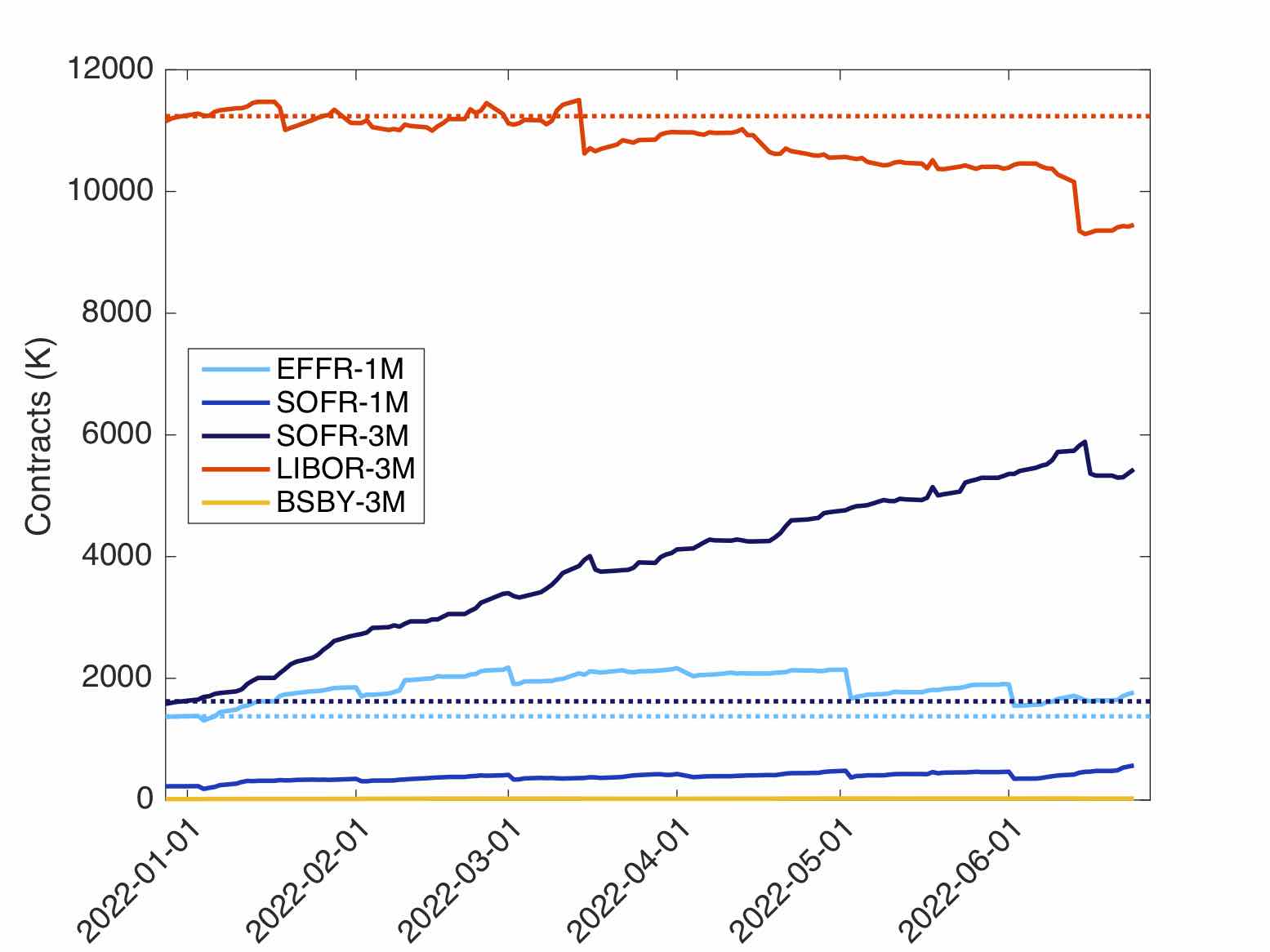
In Figure 1, the daily volume at CME is displayed. One can see that SOFR-3M futures have now a higher volume than LIBOR-3M futures. But this is a recent phenomenon that appeared only in May and the advantage of SOFR is small. Over last (short) week, the SOFR volume as only 20% higher than the LIBOR volume.

Figure 1: Daily STIR Futures volume at CME.

On the open interest side, LIBOR is still largely above SOFR with an excess OI of 75%. More details are displayed in Figure 2. Moreover LIBOR OI as only decreased slightly since the start of the year, from 11.2 m contracts to 9.6 m (-16%). A large part of the decreased came when existing contracts came to expiry. Since the beginning of the year, the total LIBOR futures volume has been 265.8 m contracts. The decrease in OI correspond to 0.7% of the traded volume. We are extremely far away from a situation were the new LIBOR trades are risk reducing!

Figure 2: Open Interest in STIR Futures.

Another feature of the futures market is the expiry date of the contracts traded. LIBOR with cease in June 2023. One could claim that trading LIBOR contracts with expiry before that date make sense from a risk management perspective and is in line with the spirit of the SOFR first requirement in the sense that those trade do not add to the transition effort which is not needed before June 2023. But the expiry profile of the futures traded does not look like that at all. If we take the traded volume for quarterly contracts on Friday 24 June, we get a expiry profile displayed in Figure 3.

Figure 3: Daily volume on 24 June 2022 for the different quarterly expiries.

The SOFR-3M futures are dominating overall, but for the maturities beyond June 2023, LIBOR is dominating. The higher LIBOR volume is even more important on a relative basis for longer expiries. If we take contracts with maturity beyond 5 years (June 2027 and beyond), the LIBOR volume is 27 times higher than the SOFR volume. Is there some market participants betting on the transition not taking place in the next 5 years?

This leads to a question we have asked for some time, without finding an answer. Or more exactly finding plenty of answers, but all bad (and scary) answers. The question is

Why do financial institution still trade LIBOR futures/swaps?

In the different seminars on SOFR that we are presenting, we use the following slide to put the question in perspective.

Figure 4: Why do financial institution still trade LIBOR futures/swaps?

  • Investment universe. SOFR products not approved by the investment committee.
  • Validation Model. validation had no time to do a full validation of the new products.
  • Systems. The system (risk/accounting) cannot cope with the SOFR products / the composition in-arrears.

Those reasons are valid reason from a very short term practical perspective, but certainly not valid 5 years after the "Future of LIBOR" speech by FCA, 4 years after the creation of SOFR and 1 year after one knows about the actual cessation date. It can take time to change systems, guidelines and validate changes. But by trading LIBOR products, you are only lying to yourself and hiding your weakness to yourself, not solving any of them. At the very least I would expect participants to trade the real think (SOFR swaps and futures), without frankensteins-like fallback, and book/report them in the best way they can. That could simply be to create swaps/futures linked to SOFR term rate (same system complexity as LIBOR) and adjust the booking as soon as possible. At least you will represent the bulk of your risk correctly and link it to SOFR!


Don't hesitate to contact us for advisory work related to the transition, the associated model developments, validation, or implementation.

Wednesday, 15 June 2022

ESTR: Volume and term rate

This week, SOFR as usual (small progress) but important news on the ESTR side. EMMI (the administrator of EURIBOR and the disappeared EONIA) has started to publish a ESTR Term rate (in beta version).

The Term rates are unfortunately not part of the fallback in the derivative ISDA definition but the Euro Risk Free Rates Working Group has recommended a forward-looking term rate as a fallback for EURIBOR for certain asset classes.

This new step in the direction of a term rate is accompanied by an important surge in the ESTR-OIS volume as can be seen in Figure 1. The weekly volume was around USD 6.8 trillions. By comparison SOFR volume was around USD 3.2 trillions, less than 50%.

Figure 1: Weekly ESTR volume at LCH.

As described in several SOFR related blogs and seminars (e.g. here), the share of the ESTR short term trades (in gray in Figure 1) is quite high. The ESTR liquidity is concentrated where it is important to have a robust ESTR Term rate. This is by opposition to USD-SOFR where only a small part of the volume is short term and the recommended SOFR Term rate is based on futures which require an arbitrary interpolation schemes and un-hedgeable time weights.

Also in relative terms, ESTR is taking more importance. As displayed in Figure 2, the ESTR share has reached 60% last week, to be compared with SOFR share at 37%.

Figure 2: Weekly share by product type at LCH.

Tuesday, 7 June 2022

LIBOR to SOFR transition: 3 June figures

The week before last saw a large increase in SOFR volumes at LCH. Last week, the SOFR share stayed high, at 38.4% but in a market with lower total volume (See Figure 1 and 2).

Figure 1: Weekly share by product types at LCH

x

Figure 2: Weekly SOFR volume at LCH and as reported by ISDA (US regulatory figures based).

The SOFR-OIS outstanding amount continues to increase steadily to reach close to USD 35 trn (see Figure 3); the amount is now largely above the EFFR amount. But the LIBOR-IRS outstanding amount is not really decreasing. At USD 82 trn, it is higher that January figures and more than twice the size of SOFR-OIS. Even if LIBOR weekly volume have decreased, the still large transacted amounts are certainly not all risk reducing. 

Figure 3: Outstanding amounts at LCH.

Tuesday, 31 May 2022

SOFR: significant increase in OTC volume

Last week has seen a significant increase in SOFR OTC volume. At LCH, the volume has been close to 3.7 trn, well above the 3.2 trn from beginning of March. The LIBOR volume has been only slightly below the year average, at 2.7 trn. The EFFR share continues to decline also. The weekly shares are displayed in Figure 1.

Figure 1: Weekly share by product types at LCH

The absolute numbers for the volume at LCH and as reported by ISDA are in Figure 2. The ISDA figures do not show such a large increase. [Note that at the time this post was first published, the ISDA figures for the week ending 27 May were not yet available; comment and graph updated accordingly].

Figure 2: Weekly SOFR volume at LCH and as reported by ISDA (US regulatory figures based).

Monday, 23 May 2022

LIBOR: Large OTC volume! SOFR: Large ETD volume!

Big increase in LIBOR OTC swaps volume this week!

Figure 1: Weekly share by product types at LCH


But on the futures side, we had, for the first time, a couple of "SOFR First" days last week from a volume perspective. The volume of SOFR-3M futures has been above the volume of LIBOR-3M futures from Wednesday to Friday (see Figure 2). The SOFR First is only in terms of volume, not in terms of open interest. In OI terms, SOFR-3M futures represent 50% of LIBOR-3M. Actually the 50% treshold was reached on Tuesday 24 May and now stands at 50.02%!

Figure 2: Daily STIR futures volume at CME.

The open interest for LIBOR-3M futures is decreasing very slowly. Since 31 December, the OI has decrease only by 7.2%. Note also that the total volume (SOFR+LIBOR) is significantly lower than previous peaks. It is not clear if this is structural or conjectural. But with uncertainty about monetary policy path, one could have expected a larger volume.

New published paper: Swap Rate fallback: unreasonable effectiveness of approximations and alternatives

A couple of months ago, we announced that the research paper written by Marc and titled

Swap Rate: cash settled swaptions in the fallback

had been accepted for publication in Risk. The article will appear in the June edition.

Since, that research has been deepened and we are pleased to announce that the follow-up article has been already accepted for publication in Wilmott Magazine. The article is titled

Swap Rate fallback: unreasonable effectiveness of approximations and alternatives.

Abstract

Cash-settled swaptions with collateral discounting are impacted by the Swap Rate fallback mechanisms decided by working groups/ISDA. The legacy vanilla swaptions are becoming exotic products, as the mechanism is based on a non-linear transformation of the OIS swap rate, and generate convexity adjustments. It turns out that those two effects almost cancel each other and lead to almost vanilla products. We analyse those cancelling effects and the risk management impacts. Based on those insights, we propose an adjusted fallback mechanism that reduces further the exotic features and simplify further the risk management of the legacy book.

The article should be published in the September issue. 

As a teaser, the graph below describes by which factor the "exoticness" of the fallback is reduced by our proposed alternative mechanism for different market movements. All the technical details are available in the paper.

Figure 1: Reduction in "exoticness" achieved by the alternative fallback proposal.


The summary of the results related to the alternative fallback method and the research paper have been communicated to the ARRC.

Added 7 June 2022: A preprint version is available on SRRN at: https://ssrn.com/abstract=4130090.


Don't hesitate to contact us if you are interested by the alternative to the ISDA fallback for swap rates. Cash settled swaption fallback can be a lot simpler than the current approach. Why not simplify your transition risk at no cost?