Wednesday, 5 October 2022

Bond futures delivery option - back to ATM

For a very long times rates on government bonds have been low. In particular they have been low with respect to the “notional rates” used in computing the conversion factors in bond futures.

Those rates were traditionally at 6.00% and are still at that level for US Treasury futures and most of German bonds futures. For the German bonds, the exception is the ultra long bond futures which are based on a 4.00% notional coupon. On the UK Gilt side, most of the notional rates are at 4.00% with the exception of the Short Gilt Futures based on a 3.00% notional coupon.

The recent market movements have brought the UK Gilt rates around 4.00%. Does this matter? What is the impact of the “notional rates” on the behaviour of bond futures?

Bond futures are settled by the physical delivery of a bond. The deliverable bonds are government bonds with a specific maturity range (plus some other conditions on size). The amount paid at delivery for the bond is the futures price multiplied by a “conversion factor” (and the notional). This conversion factor is computed (as a clean price) from the actual bond and from the notional rate. The impact of all this is that the notional rate act as some kind of strike. If the yield is below the notional rate, the shorter maturity bond is usually the cheapest-to-deliver; if the yield is above that rate, the longer maturity bonds is usually cheapest-to-deliver.

They are subtilties around that long/short maturity, in particular dependent on the coupons, as the EUR market has reminded us recently (see  Bund volatility sparks uncertainty around futures delivery).

The delivery option that had been forgotten for a long time is now back in the discussion. A good opportunity to referenced to a more than 15 years old paper by Marc: Bond Futures and Their Options: More than the Cheapest-to-Deliver; Margining and Quality Option (2006).

Obviously, the techniques to analyze this issue have evolved over the last 15 years, and we have implemented several of them. Those proprietary developments are currently not available publicly, but are available to our advisory clients.


Don't hesitate to contact us if you are interested by modelling embedded options in vanilla products.
Is SOFR first genuinely starting?

"SOFR first" has been mentioned for a long time and was suppose to start in July 2021. There have been many partial achievements along the way. To our opinion, last week was the first time we can mention SOFR First without adding inverted commas around it.

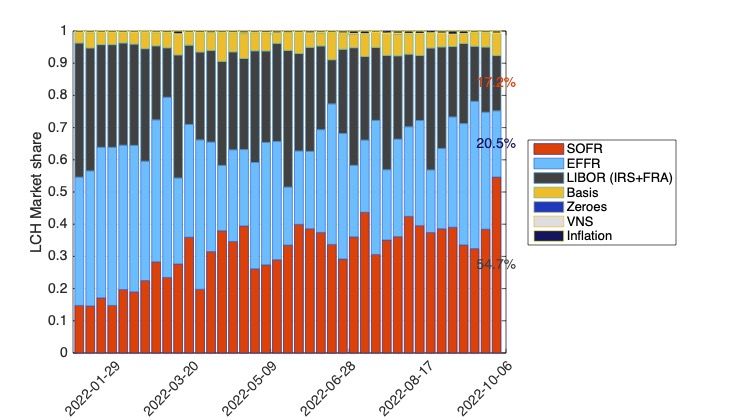
The LCH data indicates that more than 50% of the USD LCH-cleared interest rate derivatives was based on SOFR. Up to now, the achievements had been relative, like "more SOFR than LIBOR". This time, we can really say for the first time "SOFR dominates the USD rate benchmarks".

Figure 1: Weekly share by product types at LCH

Thursday, 22 September 2022

Milestone 100 trillions

Last week the 100 trillions milestone has been reached. The YTD volume at LCH passed that milestone for both LIBOR and SOFR on the same week. Emphasizing if needed that if we are in a "SOFR First" period, it is only by a very small margin.

The YTD numbers were on 2022-09-16: LIBOR 100.29 trn, SOFR 101.85 trn and EFFR ... 130.32 trn. If SOFR beat LIBOR by the smallest of margin, it is still more than 25% below EFFR.

Figure 1: Weekly share by product types at LCH

The recent period has seen several monetary policy changes in EUR and USD. The activity around those policy changes is clearly seen in the EUR-ESTR volume data, a lot less in the USD-SOFR data. For USD, EFFR still take a large part of the short term activity.

The comparison between EUR-ESTR and USD-SOFR is provided in Figure 2. The usual clear difference in the short part of the curve is clearly visible.

Figure 2: USD-SOFR and EUR-ESTR weekly volume comparison.

Wednesday, 14 September 2022

Oops again - back to SOFR Second

Each week brings a new "MyBenchmark First" moment. This week, the winner is EFFR!

Figure 1: Weekly share by product types at LCH

Friday, 9 September 2022

Back to SOFR First - LIBOR Futures transition

A couple of weeks ago we were back to LIBOR First, this week we continue the back and forth and it is ... SOFR First.

Figure 1: Weekly share by product types at LCH

On the LIBOR futures side, CME has announced its proposed conversion date for the LIBOR futures to SOFR futures: 14 April 2023. It is a good news that we now have a date. But it also means that anybody who has traded a post June 2023 LIBOR futures in the last years did not know what he was trading! The cessation of LIBOR in June 2023 has been announced a couple of years ago (on 5 March 2021) but the LIBOR fallback for one of the most liquid LIBOR instrument is only announced now. Actually it is not even the definitive fallback that is announced now, but only a "proposal" that has still to go through regulatory approval and consultation. 

What is the impact of choosing the date 14 April 2023 on the pricing of the futures? If you cannot answer that question, maybe you need external help/advise on the transition. A detail answer is part of our "Benchmarks in transition" course.


Don't hesitate to contact us if you are interested by benchmark transition advisory or training.

Thursday, 25 August 2022

LIBOR transition: Back to LIBOR first - again and again!

Last week, we were saying "SOFR: slowly getting to SOFR First"; this week it seems we have to take that back. This week title is LIBOR transition:: Back to LIBOR first - again and again!, as reference to the "LIBOR Transition: Back to "LIBOR First" - again!" post from one month ago. The reason is the same, LIBOR appears very sticky. Each time the market seems to definitively move to SOFR first, LIBOR comes back with a vengeance and take over again. 

Figure 1: Weekly share by product types at LCH

The LIBOR return is visible both in LCH numbers displayed in Figure 1 and in ISDA-US regulatory numbers visible in Figure 2. In both cases, the weekly volume for LIBOR is above the weekly volume for SOFR.

Figure 2: Weekly SOFR volume at LCH and as reported by ISDA (US regulatory figures based).

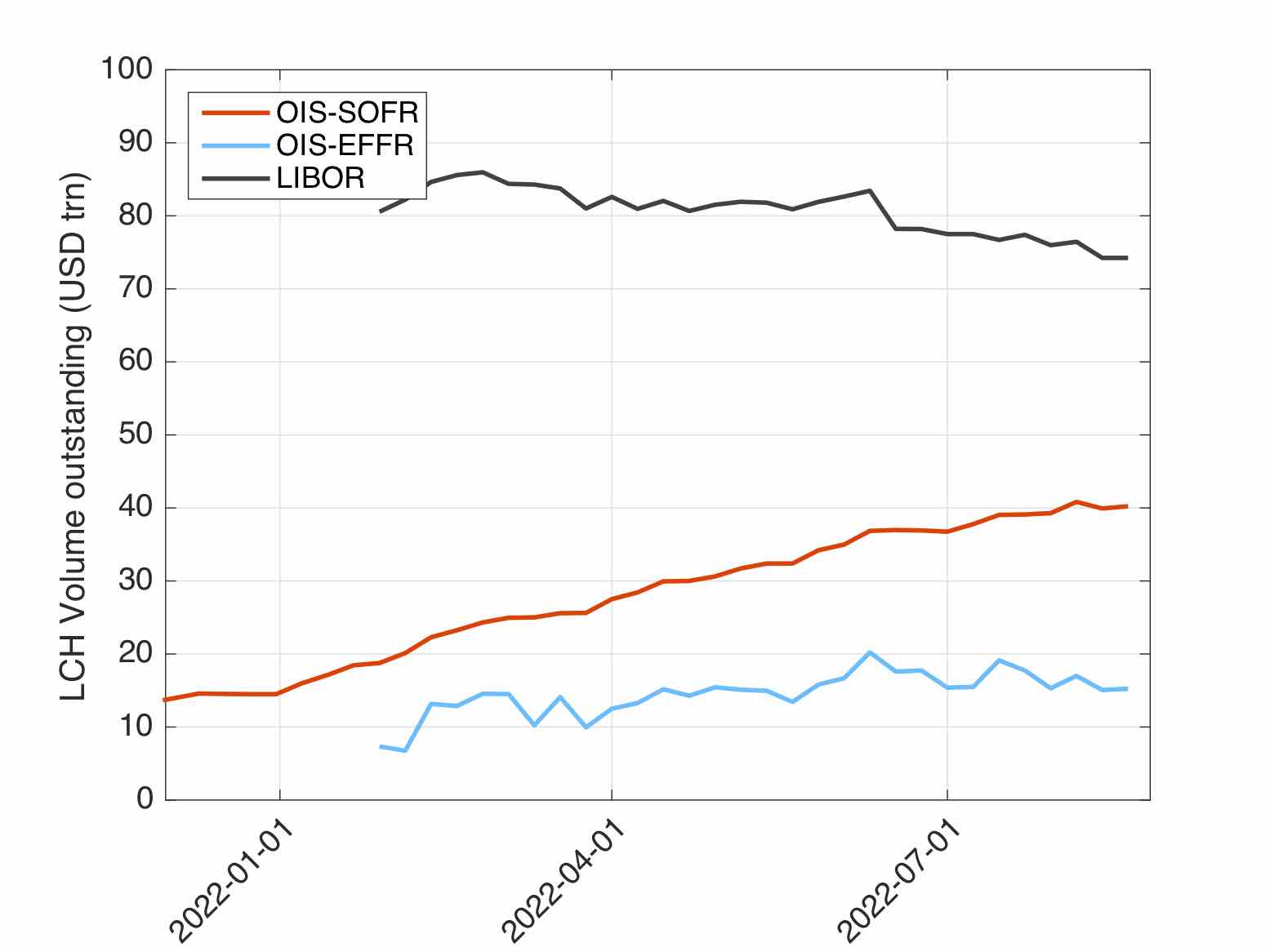
At the outstanding amounts level, the picture is not very different. Over last week, outstanding LIBOR amounts have increased (slightly). The LIBOR volume is far from being "risk reducing". The outstanding SOFR volume is below its peak from 2 weeks ago as visible in Figure 3. 

Figure 3: Outstanding amounts by benchmarks at LCH

More than 5 years after the "Future of LIBOR" speech, almost 18 months after the announcement of the definitive LIBOR dismissal and more than one year after the SOFR First announcement; LIBOR is back to the forefront.

Thursday, 18 August 2022

SOFR: slowly getting to SOFR First

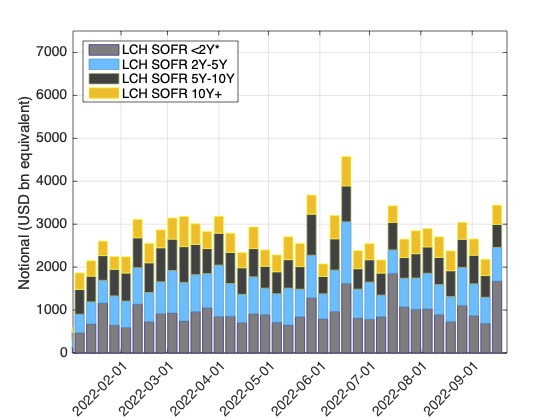
More than 5 years after the "Future of LIBOR" speech, almost 18 months after the announcement of the definitive LIBOR dismissal and more than one year after the SOFR First announcement; LIBOR is still traded in huge amounts. Only for last week LCH cleared IRS, there was 1.3 trillions USD traded.

But we see a slow progress. LIBOR volumes and outstanding notionals are slowly trending downward with some ups and downs; SOFR volumes and outstanding notionals are slowly trending upward with some ups and downs.

Figure 1: Weekly share by product types at LCH

Speaking of outstanding amount, the SOFR outstanding amount at LCH has decrease last week by 895 billions, the highest decrease ever. Nothing to be afraid of as there is a lot of short term products and they come naturally to maturity. But it may mean that we are approaching the "SOFR" peak. Note also that in term of outstanding amounts, SOFR is still well behind LIBOR with a 40 v 74 (trillions) score.

Figure 2: Outstanding amounts by benchmarks at LCH

Note that the "CME Conversion for USD LIBOR Cleared Swaps" rules have just been published. It means that since 2017, the market has been trading instrument linked to LIBOR, knowing that LIBOR would disappear and is only learning now what it has been trading for the last 5 years! Not a big success in term of transparency.

Monday, 1 August 2022

SOFR: holiday and recession

It is difficult to get a clear message from a market which is half in holiday and half in recession. From the SOFR market, we could say, once more, nothing special to say.

The share of SOFR in the LCH cleared OTC IR market is playing ups and downs around one third of hte market. The changes are as much related to LIBOR and EFFR as to SOFR. The current SOFR share is not very different from the one mid-March.

Figure 1: Weekly share by product types at LCH

On the absolute volume, the holiday mood is clear, with the current weekly volume at merely 62% of the mid-June volume.

Figure 2: Weekly SOFR volume at LCH and as reported by ISDA (US regulatory figures based).

On the subject of LIBOR transition, we looked at the outstanding notionals at LCH in the different currencies. We noticed again a relation between the transition to overnight rates and the total outstanding notionals. Since the beginning of the year, all the currencies that have fully transitioned (GBP, CHF, JPY) have seen significant decreases (GBP -15%, JPY -42%, CHF -37%), the currency that has half transitioned (USD) is almost stable (+3%) and the currency that has not transitioned at all (EUR) has seen a significant increase (+19%). The origin of this relation is not clear. It can be completely random, or it can be that the end users have decrease their risk management program as the new overnight world does not fit their needs, or it can be something else. But certainly a trend to check in the future.

Tuesday, 26 July 2022

Swap Rates and Term Structure Modelling: Implementation

Swap rate dependent products, e.g. CMS, have a long history in interest rate modelling. They look simple as only one rate is involved, but when the rate is not paid in a natural way, i.e. not according to its own annuity, they involve some type of "convexity" or "timing" adjustment.

Those products are often priced using "replication", but to do so, some approximation of the annuity discounting, or absence thereof, is used. This type of single factor approximation is what we used in our recent paper on pricing cash settled swaption through the fallback published this month in Risk (Henrard (2022)).

A very recent paper Bang and Daboussi (2022) is proposing a new approach to price swap rate dependent products in a way that preserves the full marginal distribution of all the swaps and a user selected copula between those rates.

The implementation is not trivial from a quantitative finance perspective (two changes of measure) and implementation (Monte Carlo). But by the way the numerical approach is cleverly designed, the simulations are not too costly and converge quickly.

We have adapted the methodology proposed by the authors to take into account conventions (accrual factors not all the same and the T+2 payment/effective date) and implemented it in our library. This is the library we use for consulting and model validation purposes.

The results we have observed are very good. In their paper, the authors compare the (input) market smile to the (output) model generated smile for vanilla options and find a very small discrepancy, i.e. the numerical noise is small on the present value. We have obtained the same results. We have also done the comparison for the smile risk which was not presented in the paper. We computed the sensitivities to the alpha, beta, rho and nu parameters in a SABR model. In our implementation, the sensitivities are obtained by Algorithmic Differentiation (AD) as you would expect. For a 2Yx5Y swaption, here is the comparison between the analytic result (direct formula for the vanilla) and the Monte Carlo with AD version:

As you can see, the numerical noise is below 0.05% of the actual number on the alpha-vega (a little bit higher for nu and rho). This was obtained with a relatively low number of Monte Carlo paths (1,000).

Why we are interested by this approach, beyond its natural application to CMS, is for the above mentioned fallback of cash settled swaptions with the LIBOR-linked swap rate discontinuation.

With a precise view of the term structure smile risk in CMS-like products, we can now have a look at term structure smile risk for the fallback. That will be the subject of a forthcoming blog.


Henrard, M. (2022). Swap rate: cash settled swaptions in the fallback. Risk, Cutting Edge. Published online 1 July 2022. https://www.risk.net/cutting-edge/banking/7951001/swap-rate-cash-settled-swaptions-in-the-fallback

Bang, D. and Daboussi, E. (2022). Modelling of CMS-linked products in an RFR framework, with extension to hybrids, forward starting and canary options. SSRN 4134438. https://ssrn.com/abstract=4134438


Don't hesitate to contact us if you are interested by model developments or model validation related to swap rate linked products like CMS.


Added 2023-05-07: The implementation notes for this model have now been published in the muRisQ Advisory Implementation Notes series. See the new related post.

Monday, 25 July 2022

LIBOR Transition: Back to "LIBOR First" - again!

Same title as 3 weeks ago!

LIBOR is again the first benchmark in USD this week at LCH!

Figure 1: Weekly share by product types at LCH